Kimi K3's Free 2.8-Trillion-Parameter Weights Just Landed. Here's How to Run It Inside Wirebase Today.
July 27, 2026 (3m ago)
Moonshot AI just released open weights for a frontier model at a scale no other lab has matched.
Today the company published Kimi K3's full open weights — a 2.8-trillion-parameter mixture-of-experts model, the largest open-weight release anyone has shipped. It's under the Kimi K3 License: free to run, free to fine-tune, free to build on for most teams. Two commercial catches apply. Model-as-a-Service shops clearing $20M trailing-twelve-month revenue need a separate Moonshot deal. Products past 100 million monthly active users or $20M in monthly revenue have to display the Kimi K3 name. Everyone else just downloads and runs.
On benchmarks, K3 isn't a curiosity. It's currently sitting at #2 on the Vals AI index and #3 on the Artificial Analysis Intelligence Index, and it tops the Frontend Code Arena leaderboard outright — reportedly beating GPT-5.6 and Claude Fable on a chunk of tasks, at a fraction of the API price.
So: free, frontier-class weights. Great. Now try to actually run it.
The 1.4 Terabyte Problem
Here's the part the "just self-host it" crowd glosses over. K3 activates 16 of 896 experts per token, and the full parameter set — even quantized down to MXFP4 — comes out to roughly 1.4TB of weights. In full FP16 precision that's north of 5TB. To even load the model, you need something like an 8-node cluster of 8×80GB GPUs, plus vLLM, SGLang, or TensorRT-LLM with MoE-aware scheduling configured correctly.
That's not a laptop task. It's not even a "spin up a beefy EC2 instance" task. It's a real infrastructure project, and most engineering teams — even well-funded ones — aren't going to stand up 1.4TB of aggregate GPU memory just to try a model whose weights landed today.
Which is exactly why "open weights" and "runnable today" are two different problems. The weights being free doesn't mean running them is free, or fast, or something your team should be doing manually.
Skip the Cluster. Use the Router.
Moonshot didn't just dump a tarball on Hugging Face and disappear. K3 is already live behind an OpenAI-compatible API on Moonshot's own platform ($3 per million input tokens, $15 per million output — cheap for what it does), and it's already showing up on OpenRouter, which aggregates inference from providers who did build the cluster so you don't have to.
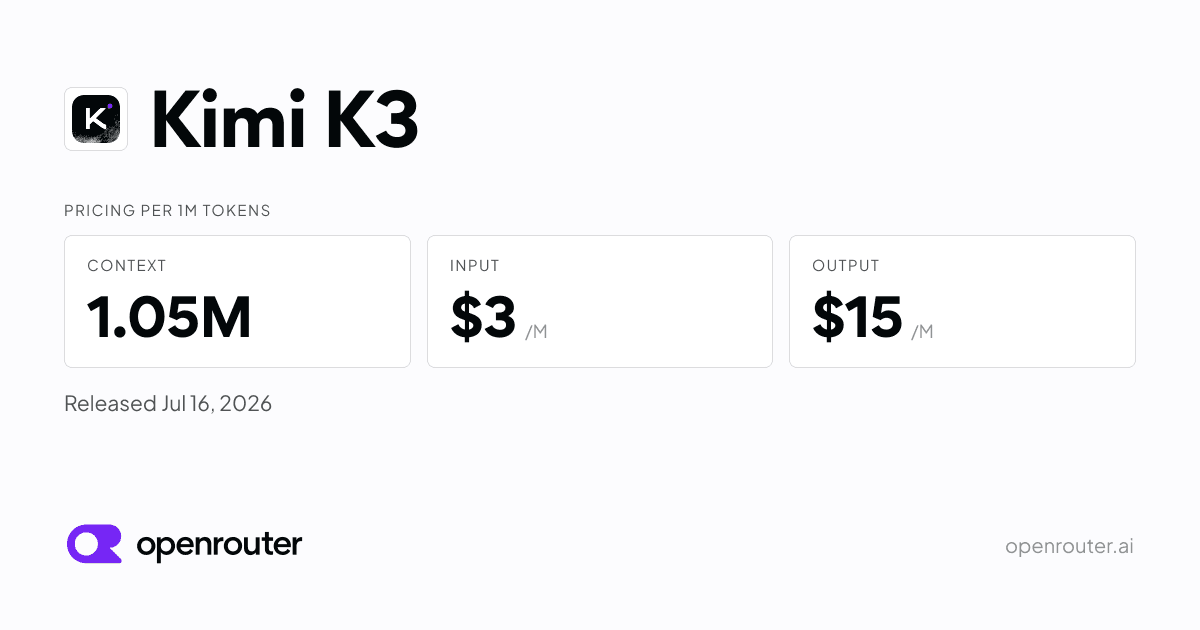 Kimi K3 live on OpenRouter: 1.05M context, $3/M input, $15/M output
That matters if you're running Wirebase, because OpenRouter is one of Wirebase's built-in providers — not a plugin, not a workaround, a first-class entry in the multi-LLM provider list alongside OpenAI, Anthropic, Google, xAI, Groq, and Ollama. Wirebase's model catalog for OpenRouter mirrors OpenRouter's live API. That means the path to chatting with Kimi K3 inside Wirebase looks like this:
- An org admin opens Admin → Models, hits refresh on the OpenRouter catalog.
- Kimi K3 shows up in the list, because OpenRouter is already serving it.
- Toggle it on.
- It's available to every user in the org, mid-conversation, right next to GPT-5.6, Claude, and Gemini.
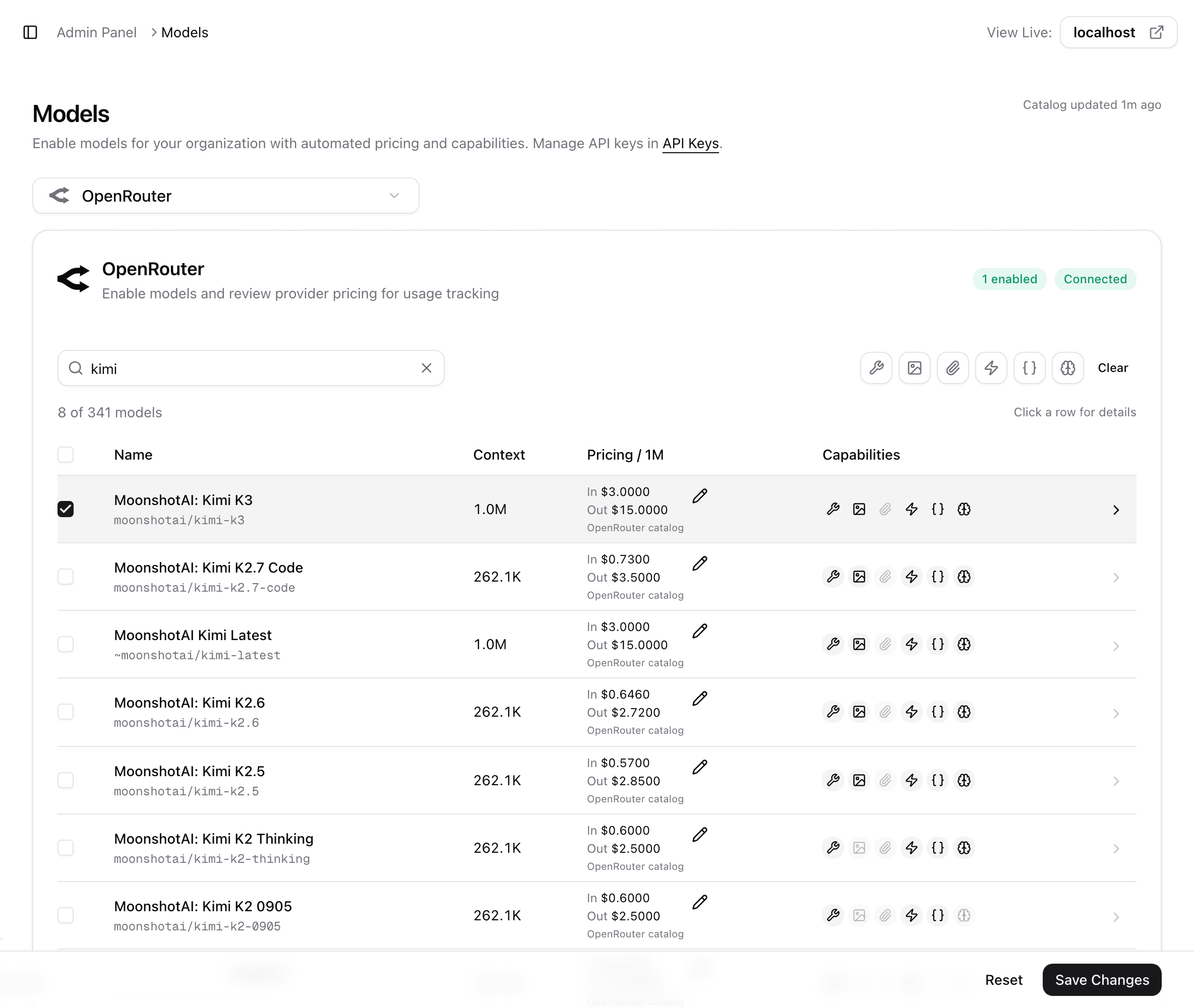
No code change. No waiting for a Wirebase release to "add support" for a model whose weights landed today. That's the actual point of a multi-LLM platform — the provider abstraction means new frontier models show up as a checkbox, not a sprint.
If You Actually Want to Self-Host It
Some teams have real reasons to want K3 running on infrastructure they control — data residency requirements, a hard rule against Chinese-origin model providers touching production traffic, or just enough GPU capacity sitting idle to make it worth the trouble. For those teams, self-hosting is still on the table, and Wirebase doesn't force a choice between "use the managed router" and "run your own weights."
Wirebase's custom provider support lets an admin point the platform at any OpenAI-compatible endpoint — your own vLLM or SGLang deployment serving K3, with an arbitrary model ID typed straight into the admin UI. No catalog dependency, no waiting on anyone. If you'd rather go the fully local route once community GGUF or Ollama-format builds land, Wirebase's Ollama integration pulls directly from whatever your Ollama server reports, wherever you run it, as long as Wirebase can reach it over the network.
Either way, the model shows up in the same interface, behind the same org permissions, next to every other model your team already uses.
The Real Story Isn't K3. It's the Pattern.
Kimi K3 is the biggest open-weight release to date, but it won't be the last one this quarter. Four frontier launches landed in the eight days before it. The pattern that matters for anyone running an AI stack isn't "which model is best this week" — it's whether your platform can absorb a new frontier model on day one without an engineering ticket.
That's the whole argument for routing through something like Wirebase instead of hard-wiring a single provider's SDK into your product: when the next 2.8-trillion-parameter model drops, you don't rebuild anything. You flip a switch.
Try Kimi K3 — or whatever ships next week — inside your Wirebase organization at wirebase.com.